Equipment
What to take on a day walk
A kit list for a day walk, arranged by priority, covering what you really need and what you can leave behind.
On a day hike, always carry between 1.5 and 3 litres of water, food, warm layers and waterproofs, and sun protection. Do not forget a basic first aid kit, a charged phone with maps and a head torch. A good target is to keep your rucksack's weight at no more than 10% of your body weight.
7 min read · updated 14 September 2026
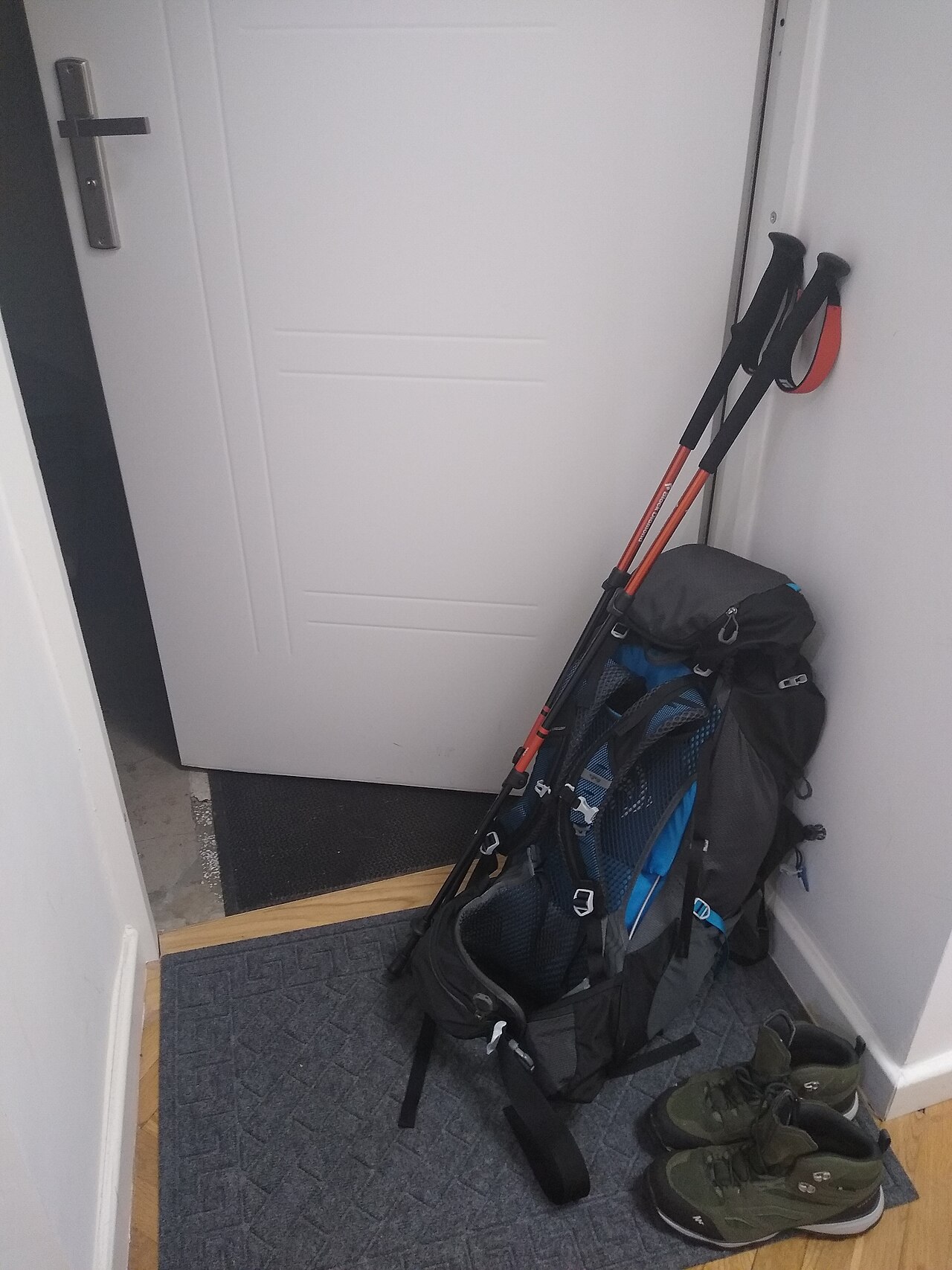
Photo: SGrabarczuk (WMF) · CC BY-SA 4.0 · via Wikimedia Commons
On a day walk, your rucksack should be light and always contain the same things. The most reliable way to avoid forgetting anything is to have a fixed checklist and go through it the night before, not on the morning of the walk.
Always essential
- Water: 1.5–2 l for half a day, 2.5–3 l in summer or if there are no safe water sources.
- Food: something solid for mid-morning and lunch, plus a snack bar or nuts kept as a reserve that you leave untouched.
- A waterproof, windproof layer, even if the forecast is sunny.
- A warm layer: a thin fleece or lightweight down jacket.
- Sun protection: sunscreen, a cap and sunglasses.
- A head torch or torch with the battery checked.
- A small first aid kit: blister dressings, gauze, medical tape, plasters, a painkiller, your medication.
- A charged mobile phone with the map downloaded, and a power bank if the route is long.
- An identity document and, if you have one, your federation membership or insurance card.
- A bag for your rubbish.
Depending on the route
- Walking poles: a great help on long descents and when carrying a load.
- An emergency blanket and whistle: they weigh almost nothing and are useful while waiting for rescue.
- Thin gloves and a hat: at high altitudes, they are needed even in spring.
- Insect repellent in damp areas and in summer.
- A filter or water purification tablets if you will be relying on natural water sources.
- Dry spare clothes to leave in the car; you will appreciate them more than you might think.
What you can usually leave behind
Crockery, a stove, duplicate clothes ‘just in case’, three walking guidebooks and a fully stocked washbag. On a day walk, you will be carrying everything you pack uphill yourself. A good aim is to keep your loaded rucksack below 10 % of your body weight.
How to distribute the weight
- Keep heavy items (water, food) close to your back at shoulder-blade height.
- Put bulky, lightweight items (warm clothing, waterproofs) at the top and sides.
- Keep anything you will need without taking off your rucksack (snack bar, cap, map) in the outer pockets.
- Do not leave anything dangling outside: it catches on branches and in narrow passages.
Warning:Check the forecast on the day of your walk, not two days before. In the mountains, a change over twelve hours can turn an easy walk into a cold, windy day.
Sources and references
General safety information only. It does not replace specific mountain training or emergency services (112 in Spain and the EU).